
The Rise of Vision-Language Models in Public Safety and Law Enforcement
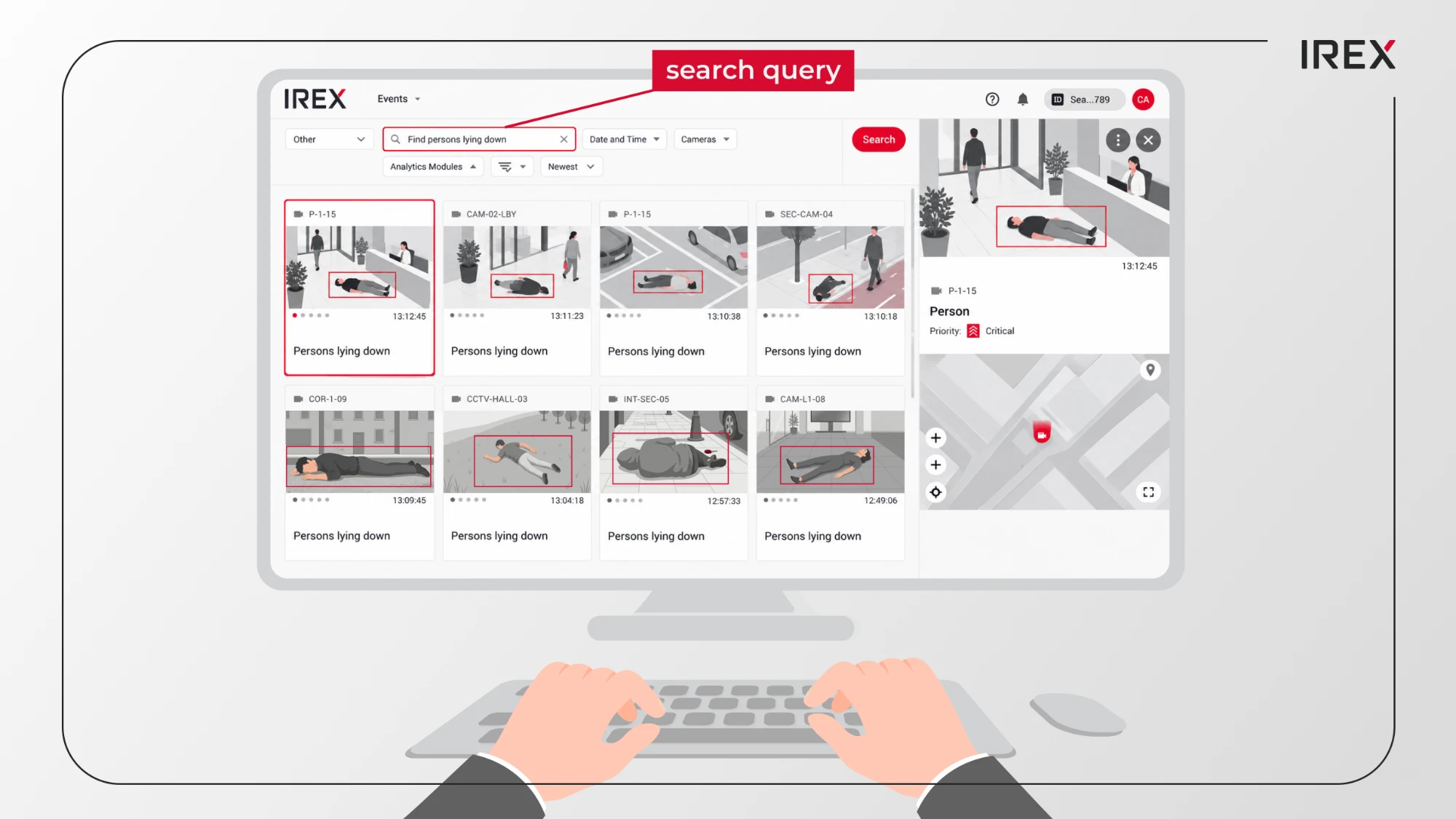
Video analytics has traditionally relied on narrow, task-specific models: people, vehicles, license plates, smoke, intrusion, and similar high-volume conditions. These models are trained on labeled data and optimized for repeatable detection, requiring a lot of time and effort.
A Vision-Language Model, or VLM, is a type of multimodal AI that connects visual information with natural language. It can look at an image or video frame and respond to a written question or instruction. In video analytics, that means an operator may be able to describe a condition: “alert when debris blocks the monitored lane”, and have the system look for it across selected cameras, without building a dedicated dataset or mode.
From trained detectors to descriptions
Traditional video analytics is excellent at repeatable, high-volume tasks. Detecting a person, a vehicle, a face in an access-control context, or a license plate requires precision, speed, and consistent performance. These systems are usually trained on large labeled datasets and optimized for one job.
A VLM is a multimodal model that connects visual input with language. Instead of returning only a class label such as “person” or “vehicle”, it uses general visual and language knowledge to evaluate whether a scene matches a description. The model can address a task it was not specifically trained on, guided by the text prompt rather than a new dataset.
This is useful for conditions that are easy to state but difficult to encode as a fixed rule. A warehouse may need to spot blocked fire exits. A transit authority may care about debris on a road. A city may want to identify illegal dumping, graffiti, or flooding. While these tasks are significant for law enforcement VLM usage, yet they might not provide enough justification to develop and maintain a site-specific model.
Traditional detectors remain preferable for high-speed tracking and consistently defined objects. VLMs in video analytics are better suited to lower-frequency, context-dependent conditions where the operational value lies in matching a description rather than tracking an object across frames.
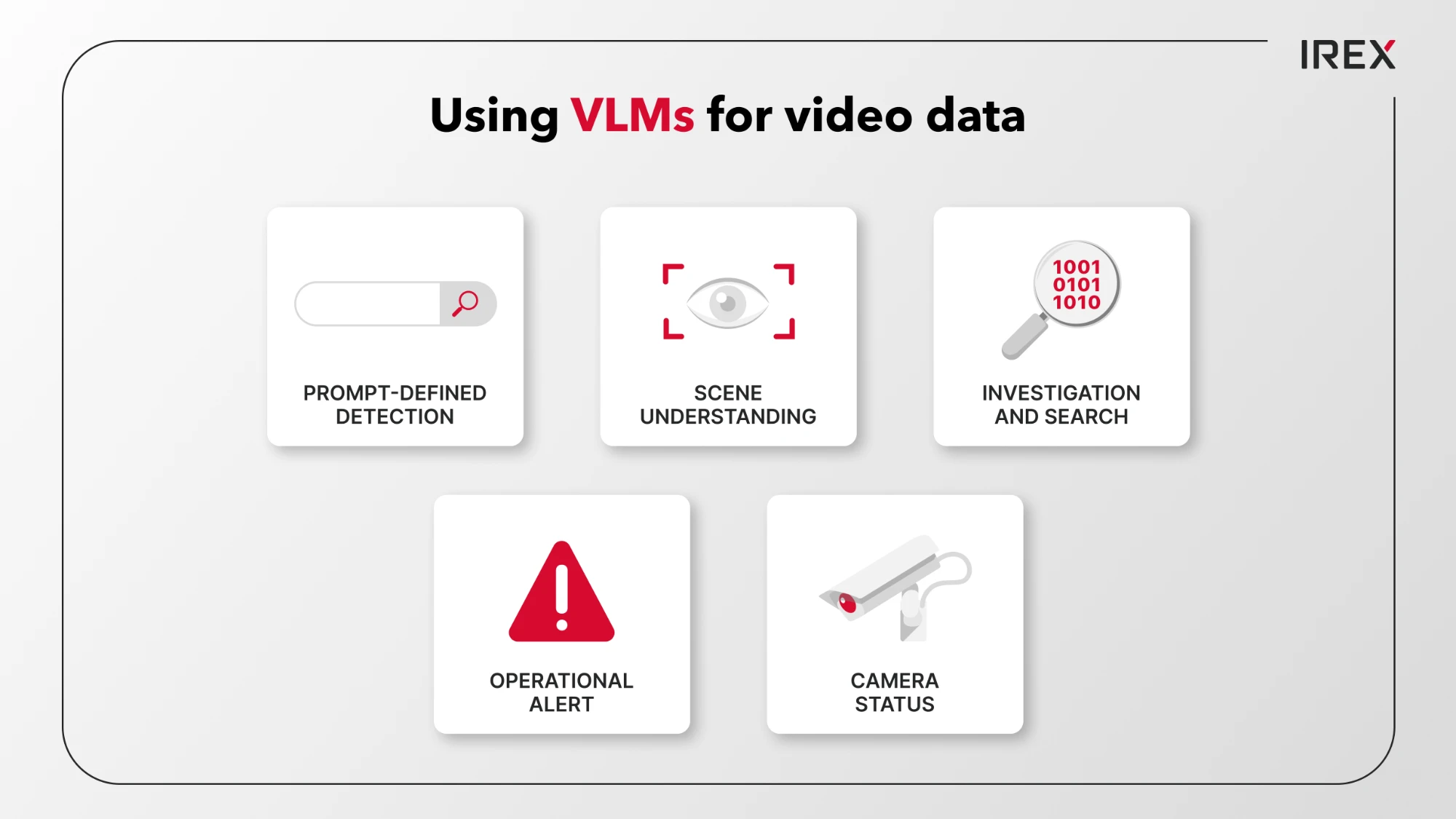
Using VLMs for video data in public safety and law enforcement
In practice, VLMs can support several parts of a video workflow:
- Prompt-defined detection: Turning a written condition into a detector for selected cameras.
- Scene understanding: Recognizing relationships and context, such as a person near a restricted area or a vehicle stopped where it should not be.
- Investigation and search: Applying a descriptive query to recorded footage rather than only live video.
- Operational alerts: Generating an event when a described condition appears, then routing it into existing alert-and-review processes.
- Camera status: Identifying obstructed, degraded, or misaligned camera views.
The important point is that a VLM does not simply label objects. It evaluates whether the scene fits the meaning of the prompt. That makes it useful for conditions that are easy for people to describe but difficult to define with a fixed rule.
Boundaries and limitations
VLMs for public safety and law enforcement are not a replacement for every analytics model. They can misinterpret context, miss fast-moving events, or produce a confident answer that is wrong - an issue commonly called hallucination. In public safety, a false alert wastes operator attention. A missed event can have more serious consequences.
VLM performance depends on camera placement, lighting, occlusion, prompt wording, confidence thresholds, and alert cooldowns. A detector should be tested against ordinary scenes that may resemble the target conditions and validated on representative footage.
That is why deployment design matters as much as model capability. A responsible system needs confidence thresholds, alert cooldowns, camera scoping, audit logs, and human review. The VLM should raise a signal, not make a decision. Operators still need the context, authority, and responsibility to verify what happened and decide what to do next.
There is also a privacy boundary to maintain. A prompt that describes a scene or condition should not become a way to identify or track individuals. In a public safety platform, VLM video analytics should be separated from identification functions and governed by the same access controls and audit requirements as other analytics.
Where IREX fits in
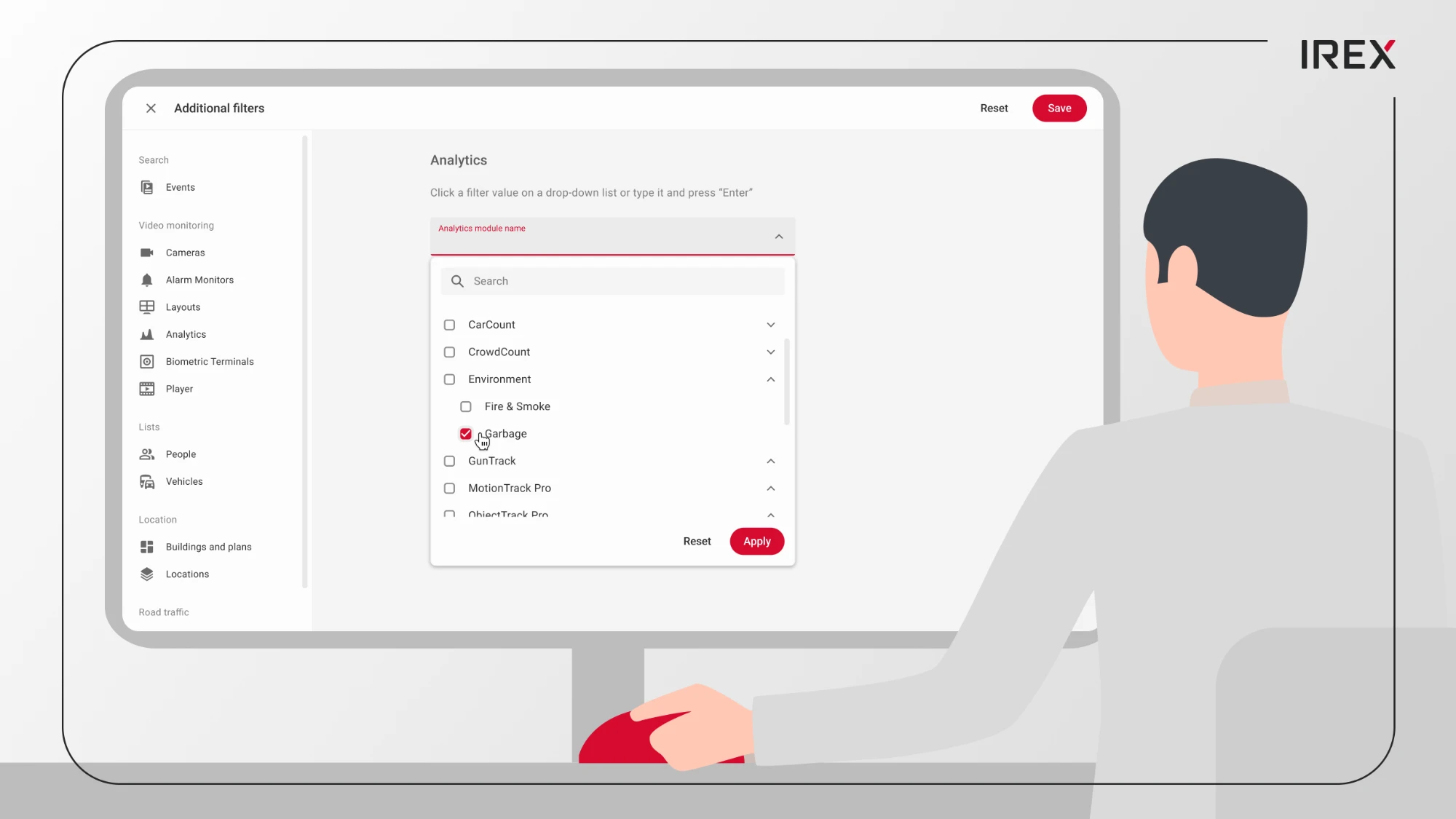
IREX applies this approach through StreamVLM™, a feature that turns a plain-language prompt into a working video detector. Operators can create conditions such as “person down”, “illegal dumping”, or “vehicle in a restricted area”, assign them to cameras, and receive events through IREX’s existing alerting, search, and investigation workflows.
Many vendors are exploring multimodal models, but the difference lies in where the VLM sits in the operational workflow, and what safeguards are in place. In IREX, StreamVLM events use the same governance framework as trained analytics: role-based access, prompt and event logging, local inference within the customer instance, and human review before any response.
IREX StreamVLM™ extends a public-safety video platform with prompt-defined detectors: describe a site-specific condition, deploy it to selected cameras, and turn it into an auditable real-time event.