
Occupancy and Lot Full
Vehicles counted inside the area a camera watches and a lot-full event the moment they outnumber the bays. Sign boards, gate policy and staffing all key off the same event.
See Jam and Lot-Full Detection
Nobody walks the deck at night. A parking structure is a large site with almost nobody in it: cameras on every level, one bar at the entrance and a team that cannot be on all of it at once.
The Capability
Occupancy is a counting problem. You mark off the area a camera should watch and say how many bays are inside it and a lot-full event is raised the moment the vehicles in that area go over the total. Sign boards, gate policy and staffing all key off that one event. The same counter detects congestion on a road segment and that is the whole of its job: it sees vehicles and counts them.
Identity is a different module. Plate recognition reads the plate and reports the vehicle’s make, model, color and type alongside it and the fuller object-class taxonomy (cars, minivans, buses, light through heavy trucks, tractor-trailers, motorcycles, machinery, trailers) is a separate module again. The counter itself classifies nothing and it is worth being precise about that before a specification says otherwise.
Entry control puts the two together. The entrance camera reads the plate of every vehicle arriving, checks it against the list of vehicles the facility allows in and passes the result to your access-control device. A permitted plate raises the bar; an unknown vehicle raises an operator alert instead of opening anything. Every one of those decisions is on the record afterwards.
Coverage
Vehicles counted inside the area a camera watches and a lot-full event the moment they outnumber the bays. Sign boards, gate policy and staffing all key off the same event.
See Jam and Lot-Full Detection →The plate read at the bar, checked against the vehicles the facility allows in. A match opens; anything unrecognized alerts an operator instead.
See License Plate Recognition →Plate plus make, model, color and type, so a vehicle involved in an incident can be found again even when nobody wrote the plate down.
See License Plate Recognition →Fire lanes, loading bays, ramps and reserved bays, watched for a vehicle standing longer than you allow there.
See Multi-Camera Traffic Analytics →A firearm shown at a pedestrian entrance, in a stairwell, an elevator lobby or at a pay station, raised at the top priority. It is the one detector here that wants a GPU on the server.
See Weapon & Gunshot Detection →A sprayed, knocked or defocused camera raises its own alert. On an unlit deck a blind camera can otherwise go unnoticed for weeks.
See Camera Tamper Detection →On Camera
The scene is illustrative and synthetic. The plate in it is an invented, non-issued combination and the event is an access decision rather than an identification.
The entrance camera reads the plate on approach and checks it against the vehicles the facility allows in. A permitted plate tells your access-control device to raise the bar; anything unrecognized raises an operator alert and the bar stays down. Nothing here opens on a guess and every one of those decisions is on the record afterwards with the operator, the time and the grounds attached.
License Plate Recognition →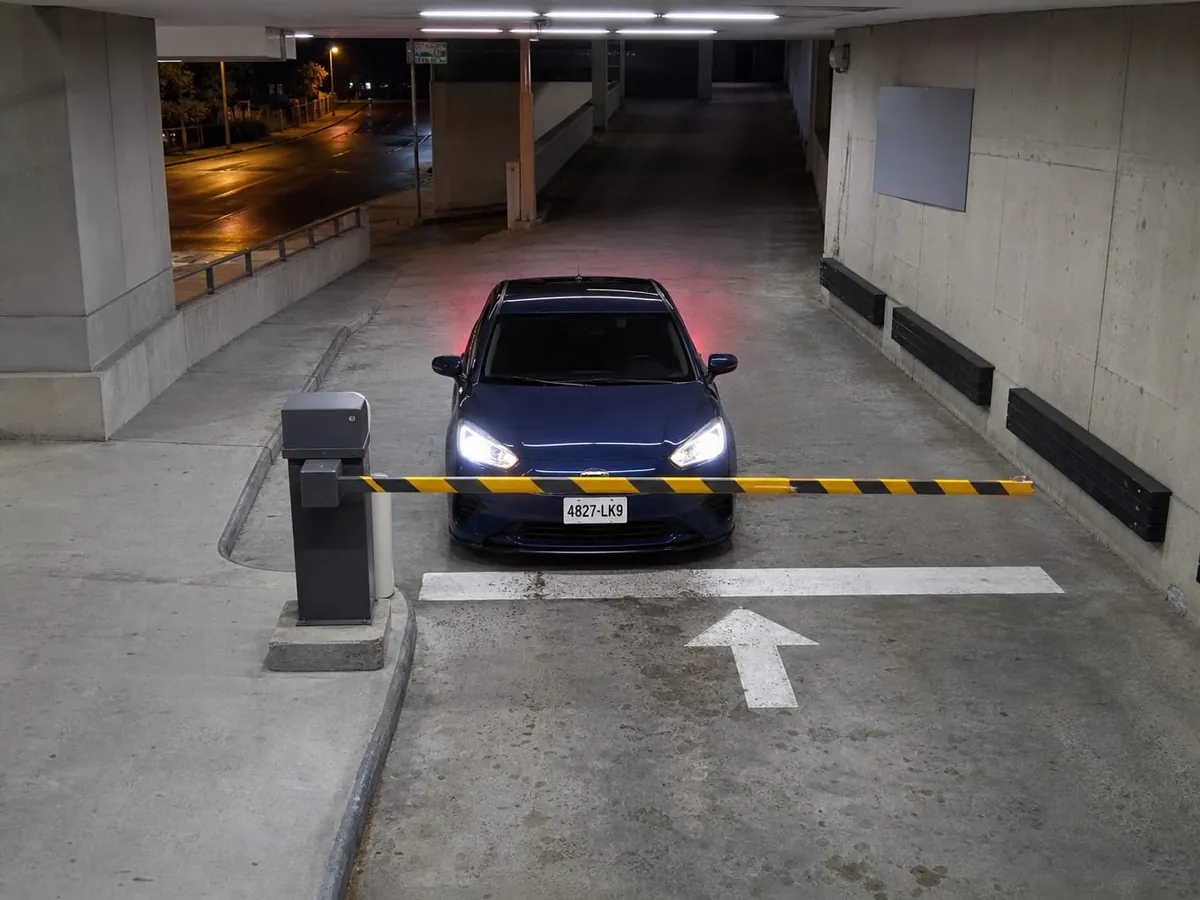
Entry Control
Barrier control is not a black box. Four things have to be true at the entrance and they are worth understanding before anyone signs for it.
A camera aimed along the lane, with enough resolution on the plate where a vehicle actually stops. The wide camera that watches the deck is the wrong one for this job and that is an optics and placement question rather than a software one. A site survey settles it.
License Plate Recognition →A vehicle pulling up to the bar is what triggers the check, so the plate is read on approach rather than after somebody presses a button. The camera has to see the whole vehicle, not a plate clipped by the edge of the frame.
Tenants, staff, contractors, deliveries: whoever the facility allows in goes on a vehicle list you maintain and access to that list is granted by role like every other list on the platform.
A permitted plate tells your access-control device to raise the bar. Anything unrecognized raises an operator alert and the bar stays down, which is the behavior you want at four in the morning.
Keep Reading
One entrance, one deck and a week of your own traffic tells you more about parking analytics than any specification sheet.
No and it is worth being exact about it. The counter behind occupancy, CarCount, sees vehicles as one class and counts them inside the area you mark off, which is precisely what a lot-full threshold and congestion detection need. Make, model, color and type come from CarTrack Pro alongside the plate and the wider object-class taxonomy comes from ObjectTrack Pro. Classified counting is not a documented CarCount output and we do not claim it.
It can drive the device that raises it. A plate read at the entrance is checked against your permitted-vehicle list and the result is sent to your access-control device, so the bar rises on a match and an unrecognized vehicle raises an operator alert instead. Sigur is documented as an access-control integration and Netping as an external device; beyond those, any system reachable over HTTP can be driven from an alarm.
That is a placement and optics question rather than a software one and it is the first thing a site survey settles. Plate reading needs a camera aimed along the lane with enough resolution on the plate where the vehicle actually stops; the wide camera that watches the deck is the wrong one for the job. We publish no accuracy figure: it is benchmarked on your own cameras during the pilot and the measured numbers go into the contract.
It depends on your jurisdiction and on the basis for your permitted-vehicle or flagged-vehicle list and that is a question to settle with counsel before deployment. The platform supports it the same way it supports every privacy-sensitive action: the operator records the lawful grounds before the action runs and the record is append-only and auditable. IREX also runs background checks on prospective clients and declines business it judges high-risk on data collection and security.
You do. Customers retain 100% ownership and control of their data and IREX neither owns nor accesses customer video, events, logs, watchlists, or floor plans. On-premises deployment is the data-residency mechanism.
With a pilot: one site, three to five use cases, six to twelve weeks and two or three measurable success criteria agreed in writing before it begins. Accuracy is benchmarked on your own cameras and the measured numbers go into the contract.