
Vandalism and Graffiti
Damage is expensive because it is found the next morning. A detector written as a sentence fires on the act instead.
Explore StreamVLM™
Thousands of sites and nobody standing at any of them. A bus network is not one site with many cameras: it is many sites with a few cameras each, no staff on site and a connection that may or may not be there, which is a deployment problem before it is an analytics problem.
The Constraint
A metro station has hostile lighting and excellent fiber. A bus shelter is the opposite: daylight is usually fine and there is no fiber at all. That single difference decides the architecture.
The answer is a single cost-effective edge server at the stop. Analytics run locally and only events cross the link, so bandwidth stops being the limit. When the link drops the site keeps recording and detecting and synchronizes automatically once it returns. The failure mode of a dispersed network is a site going quiet without anyone noticing and that is the failure this design removes.
The detectors themselves are the ones the rest of the network already runs. Nothing on this page is a bus-specific product; it is the same catalog, configured for a site nobody is standing in.
Coverage
Damage is expensive because it is found the next morning. A detector written as a sentence fires on the act instead.
Explore StreamVLM™ →Dwelling where and when dwelling is itself the signal — an empty shelter at 3 a.m. is a different rule from a queue at 8 a.m.
See Perimeter Intrusion Detection →A bag or a box left at a shelter, on the same detector the interchanges run and set for a site with far less passing through it.
See Abandoned Object Detection →On a network nobody visits, an obstructed or repositioned camera is an unmonitored site. A sprayed lens or a knocked mounting raises its own alert.
See Camera Tamper Detection →Weapon detection at shelters and interchanges, routed to the operator with the frame attached rather than discovered afterwards.
See Weapon & Gunshot Detection →Vehicles stopped in a bus lane or across a stop box and motorbikes using the lane, detected as a traffic-enforcement violation with an evidence package.
See Multi-Camera Traffic Analytics →On Camera
The scene is illustrative and synthetic. It shows the ordinary case this deployment is built around: an event with no staff, no passer-by and no one to report it.
A shelter is a site with a handful of cameras, no staff and a link that may or may not be there and the damage is normally discovered by the first inspection of the next day, by which time the repair is scheduled, not prevented. The detector fires on the act instead and because the analytics run on the edge server at the stop rather than in a data center, only the event crosses the link. When the link is down the site keeps recording and detecting and synchronizes when it returns.
Explore StreamVLM™ →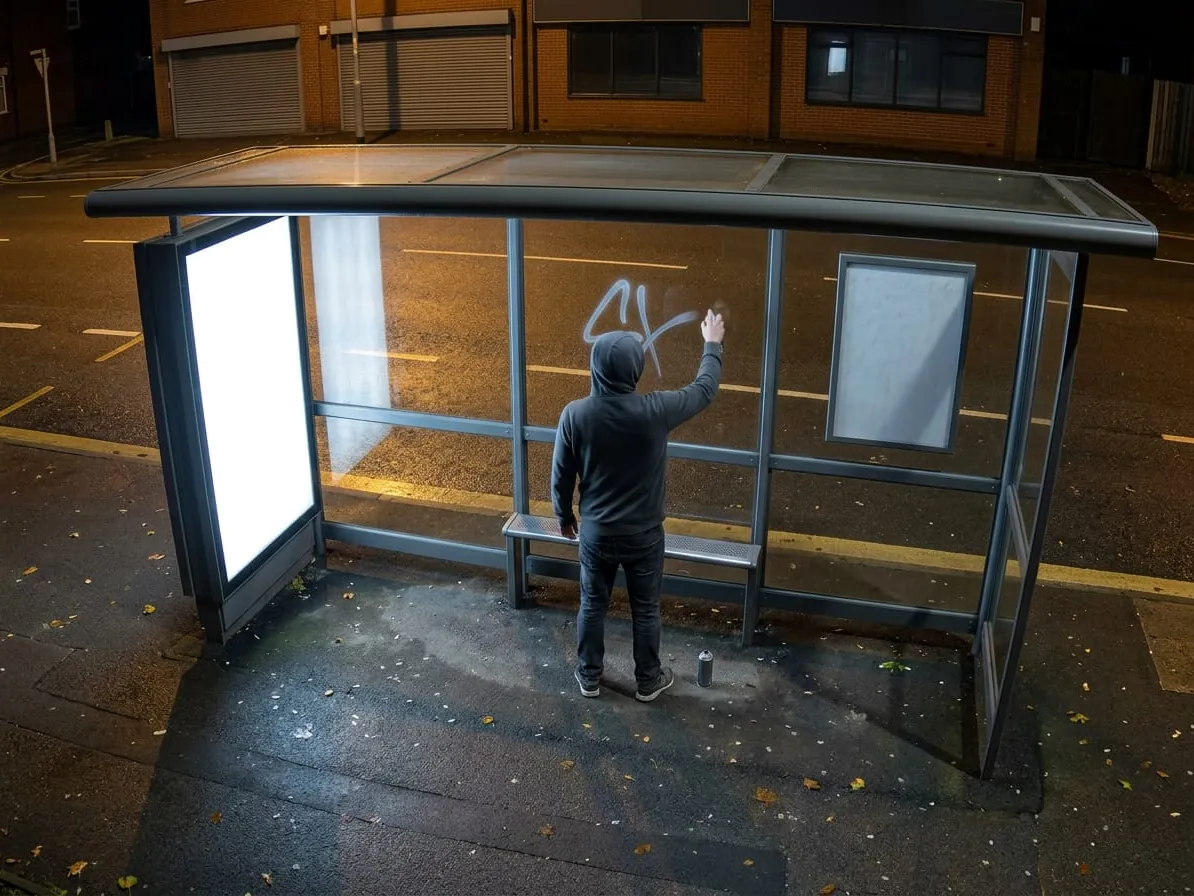
Keep Reading
One bus corridor, instrumented end to end, answers the connectivity question for the whole network far faster than a paper study.
No, it is the normal case for this kind of deployment. An edge server runs the analytics at the stop and sends only events, so the link carries a fraction of the data raw video would need. It keeps recording offline when the link drops and synchronizes automatically on recovery.
No. Any camera that supports ONVIF or streams RTSP with H.264 or H.265 on a static IP can be connected and each module then sets its own resolution and placement requirements, which a site survey confirms. Connection is not plug-and-play: a qualified network engineer configures each camera and router.
The detectors are the same and the architecture is not. A metro network is a small number of dense, well-connected sites; a bus network is a large number of sparse, poorly connected ones. The railways page describes the first, this page the second.
You do. Customers retain 100% ownership and control of their data and IREX neither owns nor accesses customer video, events, logs, watchlists, or floor plans. On-premises deployment is the data-residency mechanism.
With a pilot: one site, three to five use cases, six to twelve weeks and two or three measurable success criteria agreed in writing before it begins. Accuracy is benchmarked on your own cameras and the measured numbers go into the contract.