
Red Light and Stop Line
Signal-correlated, across every lane on the approach.
See Multi-Camera Traffic Analytics
Enforcement programs fail on evidence quality and on manual compilation. IREX coordinates cameras across an intersection and assembles the case automatically, which is what makes volume at this level possible.
In Production
Mongolia was the first country to deploy IREX multi-camera traffic analytics for nationwide enforcement. The installation spans the country, including Ulaanbaatar and enforces red-light violations, stop-line infractions and lane-direction controls. It also detects congestion in real time and calculates average speeds between intersections, which is the data road authorities need to optimize flow rather than only to fine drivers.
In Peru, traffic analytics runs with specialized two-wheeler detection critical to the region. In Southern California, police use it to manage congestion and identify violations across busy urban corridors. One city deployment detected 2.3 million violations in a single year.
In January 2025 IREX shipped what it recorded as the world’s first cloud-based multi-camera traffic management system.
Coverage
Signal-correlated, across every lane on the approach.
See Multi-Camera Traffic Analytics →Driving in the opposite lane (wrong-way driving), overtaking where it is prohibited and forbidden maneuvers at intersections.
See Multi-Camera Traffic Analytics →Failure to yield to pedestrians and near misses.
See Multi-Camera Traffic Analytics →Illegal parking and shoulder breakdowns.
See Multi-Camera Traffic Analytics →Spot and average-speed control between intersections.
See Multi-Camera Traffic Analytics →Crossing violations, with a dedicated camera specification.
See Multi-Camera Traffic Analytics →Motorbike detection with rider count and helmet checks, motorbikes in restricted lanes and zones and bike-lane obstruction.
See Two-Wheeler Analytics →Real-time congestion, heatmaps and average-speed statistics.
See Multi-Camera Traffic Analytics →On Camera
A signal violation, a right-of-way conflict, livestock on a rural highway and a load shed across two highway lanes. Four different problems, one camera network, one evidence package.
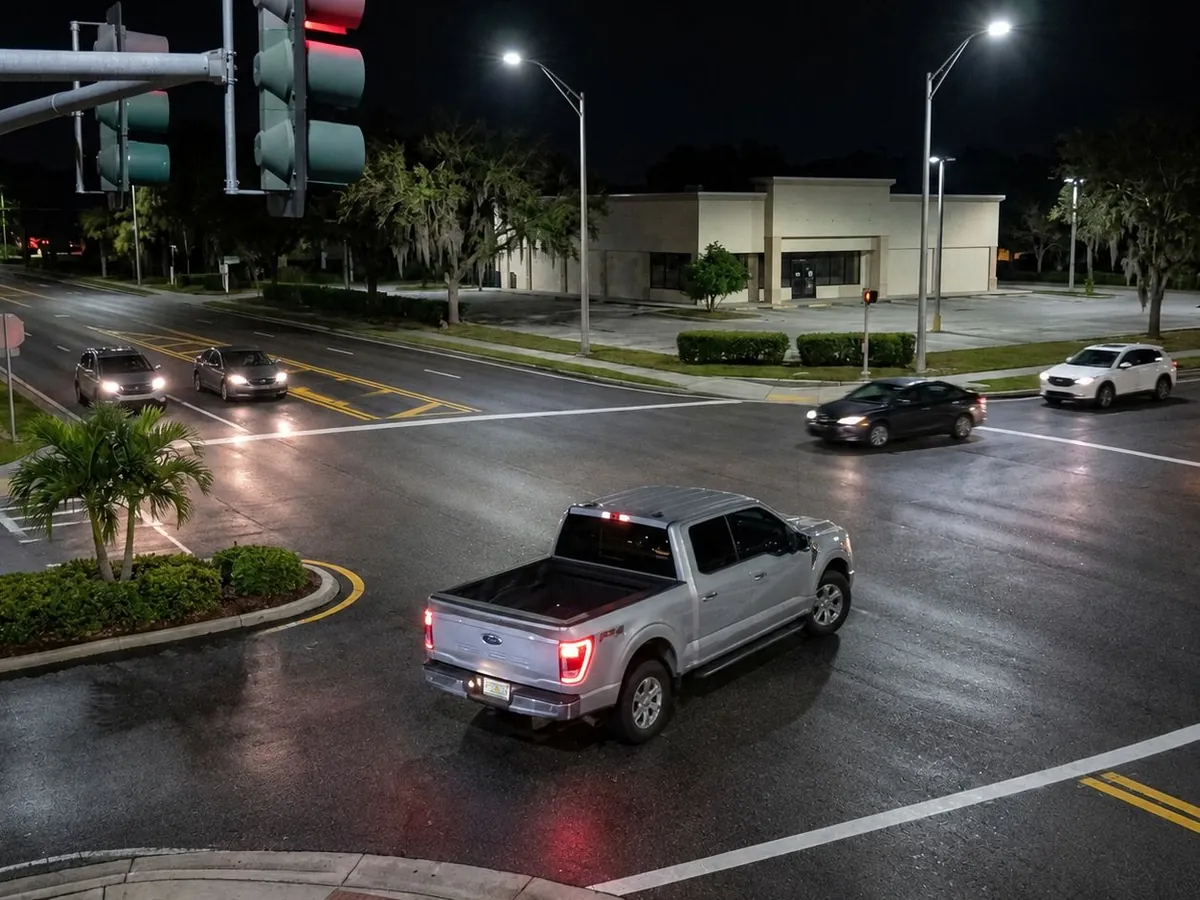
The violation is read against the signal state rather than inferred from the video, across every lane on the approach. Automated red-light enforcement is a state-by-state question in the US and a deployment follows the local law.

Failure to yield is citable; the near miss beside it is not and a city normally never hears about it at all. Both are counted here, which is what turns a bad intersection into a case for redesigning it.

On an intercity road this is a fatal-collision class, not a curiosity. It is also the clearest example of a detector a national program needs and no catalog ships.

Debris, a shed load and a stopped vehicle are one detector class. The alert is the difference between a queue and a secondary collision.
Keep Reading
One intersection, done to specification, tells you what a citywide program will actually yield.
That is what the per-violation installation specifications are for: defined camera roles, positions, angles, resolutions and field-of-view rules, verified in a site survey. The platform then assembles the plate photo, vehicle context, signal state, timestamps, camera identities and clip into one package with no manual compilation.
Sometimes. Enforcement is the strictest analytics use case. Documented specifications run 1920 × 1080 up to 2560 × 1920 at 12 to 25 fps, H.264 or H.265 at 1 to 6 Mbps with CBR preferred, ONVIF Profile S or G, PoE, IP66 and −30 °C to +40 °C. Cameras outside that may need replacing or supplementing and that is excluded from standard proposal scope.
Yes. Each violation assembles a complete evidence package and the integration into your citation or fine-processing system is scoped during design.
With a pilot: one site, three to five use cases, six to twelve weeks and two or three measurable success criteria agreed in writing before it begins. Accuracy is benchmarked on your own cameras and the measured numbers go into the contract.