
Weapon Detection
A firearm shown on campus and the gunshot, scream or breaking glass that goes with it. The detector was reworked specifically to reduce false alerts.
See Weapon & Gunshot Detection
The cameras are there and nobody is watching them. Most schools already have security cameras meant to provide situational awareness and no administrator or teacher can watch them continuously, so detection begins when a person happens to notice.
The Three Factors
In an active-shooter situation three factors determine the outcome: how quickly it is detected, how quickly the right people are notified and how quickly they can respond. In a typical incident police are notified after shots have been fired and the call then travels through routing and information-gathering before dispatch.
AI closes the first two gaps. Detection runs continuously on the existing camera network and the alert reaches staff, school security and law enforcement at the same moment, with the triggering frame and the camera location attached. IREX has been selected as a school-safety vendor in Humble, Texas and works on school-safety programs and drug-distribution prevention with school districts.
For the response phase, watchlist face recognition and appearance-based re-identification let responders track a subject through corridors across cameras even if clothing changes, indoors on floor plans, so they arrive knowing where the subject is now rather than where they were.
Coverage
A firearm shown on campus and the gunshot, scream or breaking glass that goes with it. The detector was reworked specifically to reduce false alerts.
See Weapon & Gunshot Detection →Face-based access control with liveness and anti-spoofing at controlled entries and watchlist alerts for barred individuals.
See Access Control & Anti-Spoofing →Following a subject from camera to camera indoors, on the building floor plan, carried by appearance when the face is not visible.
See Person Re-Identification →Intrusion detection and restricted-zone monitoring when the campus should be empty.
See Perimeter Intrusion Detection →Density monitoring at entrances, assemblies and events, with precise counting for drill review.
See Crowd Management →What your campus actually worries about, described in a sentence rather than waiting for a vendor module.
Explore StreamVLM™ →On Camera
The scene is illustrative and synthetic and no child appears in it. The frame is composed so there is none to hide. It shows the precursor, not an incident.
Classes are in session, so nobody is outside to see him and nobody has raised anything. That is the gap the detector closes: detection runs continuously on the cameras already covering the entrance and the alert reaches staff, school security and law enforcement at the same moment with this frame and the camera location attached. In a typical incident the first call goes out after shots have been fired and then still has to travel through routing and information-gathering before dispatch.
Weapon & Gunshot Detection →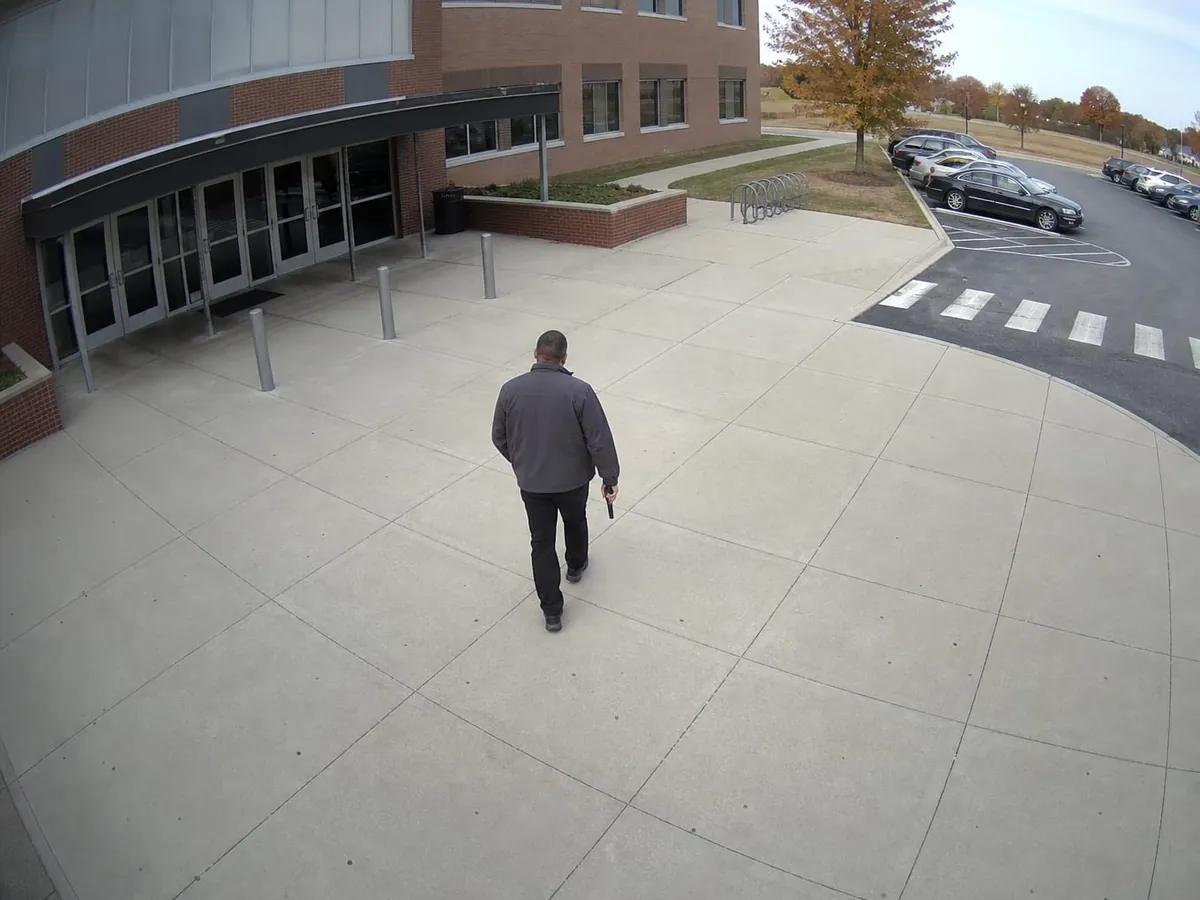
For the School Board
Keep Reading
An hour on site with your security lead tells you more about school-safety analytics than any datasheet.
Usually not. If a camera supports ONVIF or streams RTSP with H.264 or H.265 on a static IP, it can be connected. Weapon detection needs a clear, higher-resolution view of the scene and placement matters as much as specification, which is what a walkthrough establishes.
We do not quote a figure, because IREX policy forbids "guaranteed detection" wording and the wiki holds no published per-module accuracy number. What we commit to is measuring it on your own cameras during the pilot against criteria agreed in writing and putting the measured numbers in the contract.
Frequently and grant-matched programs are a recognized sales motion. We supply the technical specifications, reference designs and bid support the application needs; the grant strategy itself is yours.
You do. Customers retain 100% ownership and control of their data and IREX neither owns nor accesses customer video, events, logs, watchlists, or floor plans. On-premises deployment is the data-residency mechanism.
With a pilot: one site, three to five use cases, six to twelve weeks and two or three measurable success criteria agreed in writing before it begins. Accuracy is benchmarked on your own cameras and the measured numbers go into the contract.