
Safer Protests: How IREX Helps Protect People, Businesses and Public Facilities
Public-safety analytics can help cities respond to objective hazards during demonstrations while protecting lawful assembly, human judgment and accountable investigation.
Public demonstrations are part of democratic life. Cities must protect the right to assemble while also protecting demonstrators, bystanders, emergency workers, businesses and public facilities.
That balance becomes difficult when a peaceful gathering is accompanied by fire, crowd compression, property damage, looting or attacks on responders. The answer is not to treat every protester as a threat. It is to identify objective safety events, direct human attention and investigate specific incidents with reliable evidence.
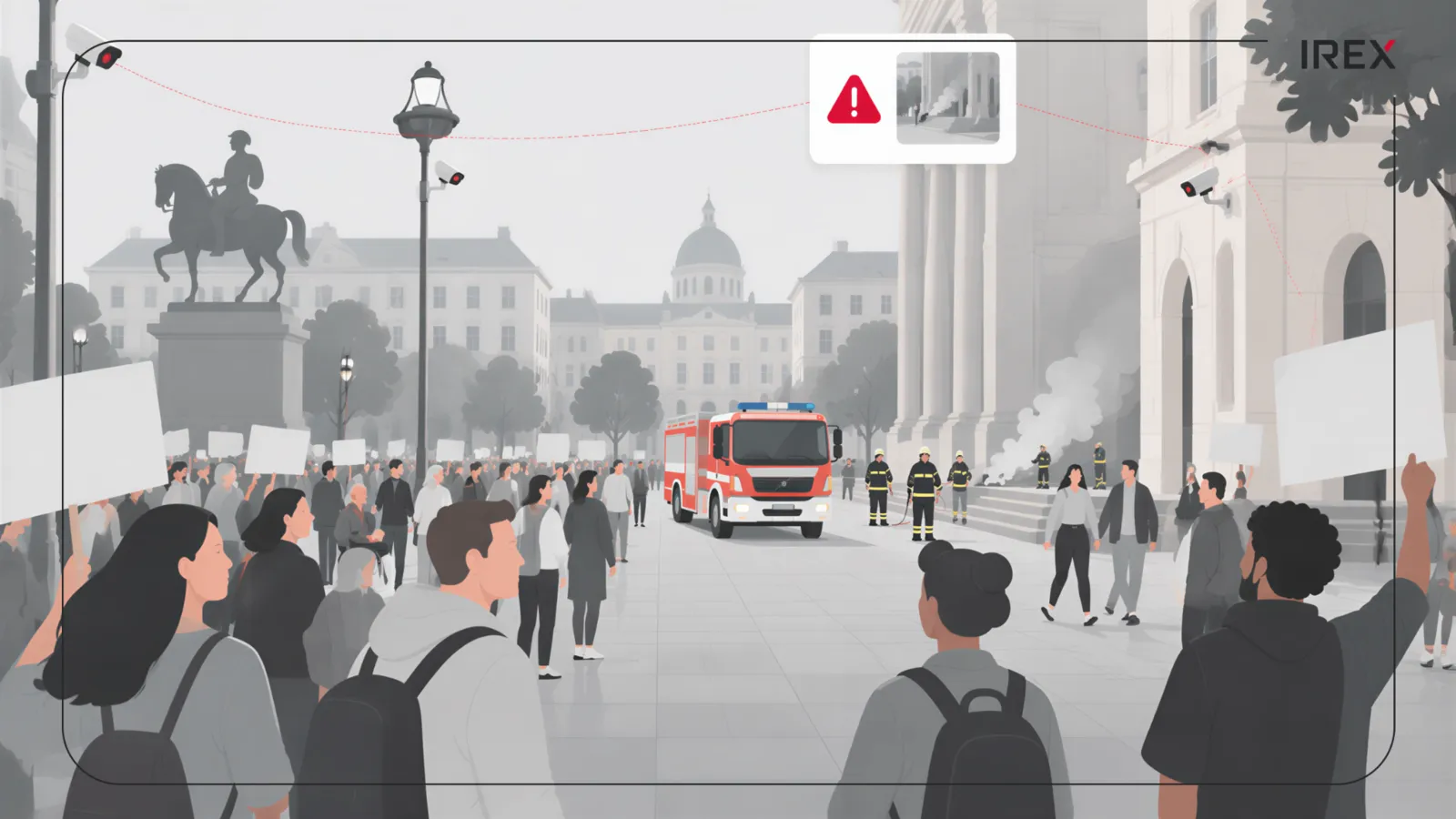
Public-safety analytics can help responders focus on verified hazards while protecting lawful assembly.
IREX helps public-safety teams do that with existing camera networks, real-time analytics, authorized investigations and accountable collaboration. The platform does not assess political intent or decide whether an assembly is legitimate. It helps trained people respond to observable events and investigate defined cases.
What 2026 protests show
Recent incidents across Europe illustrate the need for practical, event-based response.
In France, the Interior Ministry’s provisional assessment of the October 24, 2026 mobilization recorded 289 demonstrations or actions, approximately 410,000 participants, 1,314 arrests, 53 injured law-enforcement officers, 75 fire-related interventions and 24 looted businesses. The figures point to a complex operating environment where responders must distinguish a large peaceful gathering from specific hazards and offenses.
In Italy, clashes around Turin–Lyon rail construction sites in the Susa Valley on July 25–26 reportedly injured 126 law-enforcement officers. The project company estimated approximately €1 million in damage at the Chiomonte site, according to ANSA. On October 17, a cost-of-living protest in Milan escalated into clashes, fires, vandalism and looting. ANSA reported 14 injured police officers.
In Spain, a housing demonstration in Barcelona on October 5–6 reportedly ended with fires, clashes, 13 arrests and approximately 30 injured Mossos officers, according to EFE. In Bilbao, the Ertzaintza reported 17 detentions and one investigation after disturbances on October 27, with damage reported to urban furniture, vehicles and businesses.
In Poland, the government maintains monthly protest and strike reports. In October, the Interior Ministry reported that an officer was attacked near a protest outside the Constitutional Tribunal and that a suspect was detained. The official statement illustrates why responders need a verified event record rather than a generalized suspect list.
These cases are different in scale and legal context. They do share an operational requirement: responders need reliable information about what is happening, where it is happening and what evidence remains afterward.
Before the event: configure the camera network around real risks
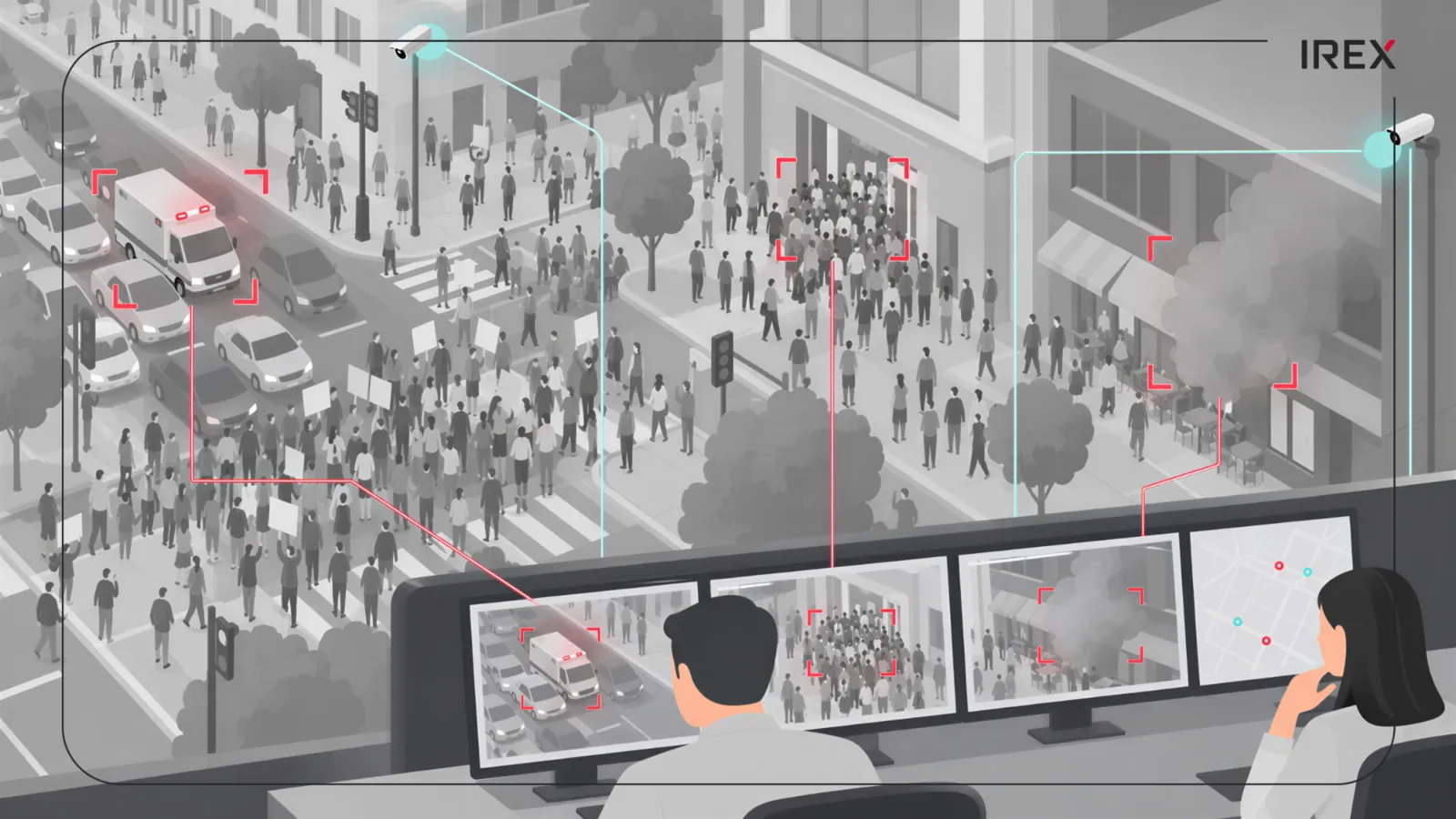
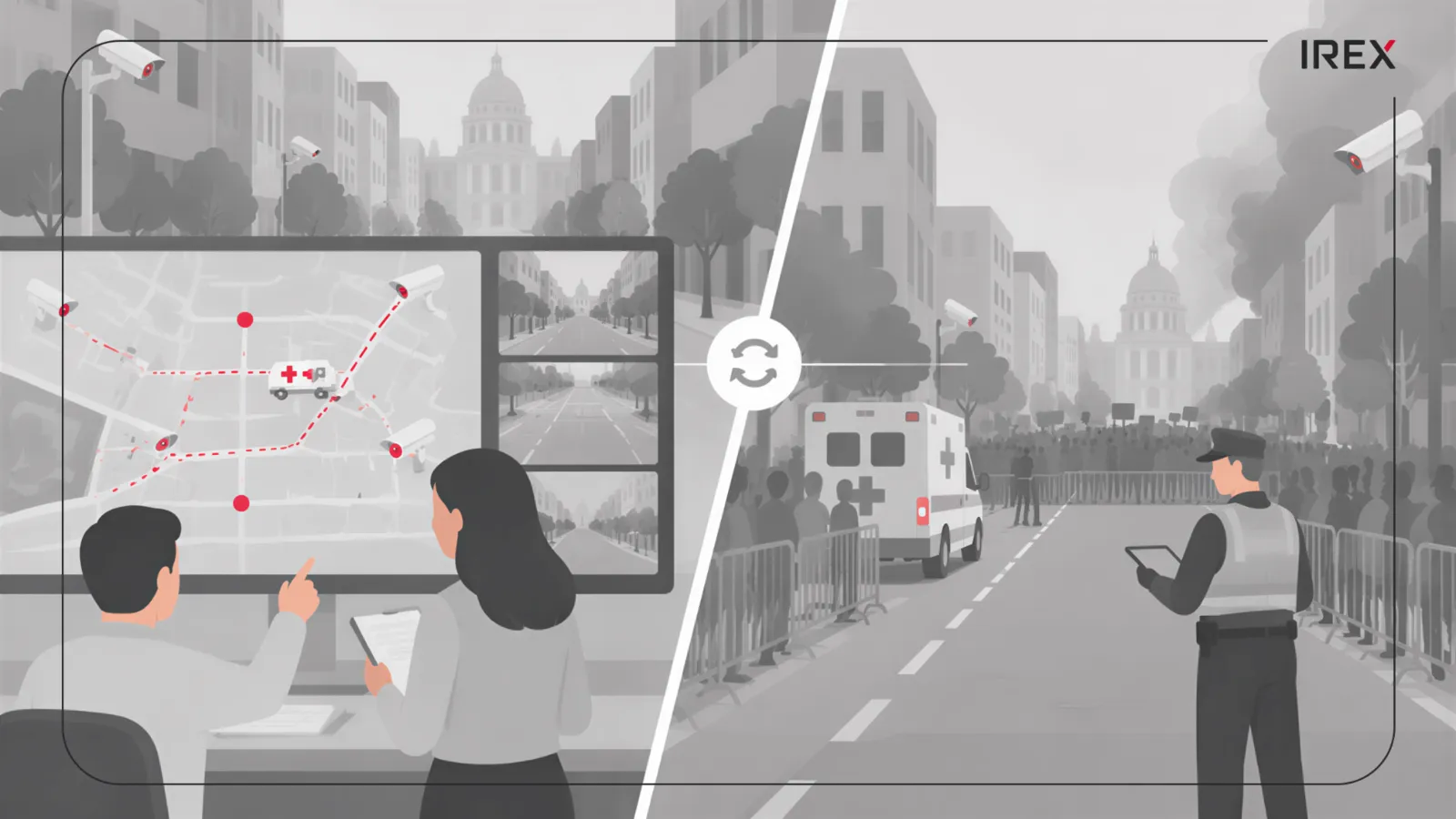
Objective alerts can help responders keep emergency access open without treating a gathering as a threat.
IREX can organize existing cameras around transit entrances, emergency routes, public buildings, commercial corridors and critical infrastructure. The purpose is not to profile a political movement. It is to define objective questions:
Is a crowd becoming dangerously dense? Has fire or smoke appeared near a building? Has an unattended object been left in a sensitive location? Has someone crossed a restricted perimeter? Has a camera been obstructed? Has a gunshot, scream or glass break been detected?
IREX analytics support these questions directly. CrowdCount detects dangerous crowding and supports post-event counting. FireTrack detects fire and smoke. ObjectTrack Pro detects abandoned objects and loitering. MotionTrack Pro detects perimeter intrusion. AudioTrack detects gunshots, screams and glass breaks. GunTrack detects weapons. TamperTrack identifies camera obstruction, repositioning and quality degradation.
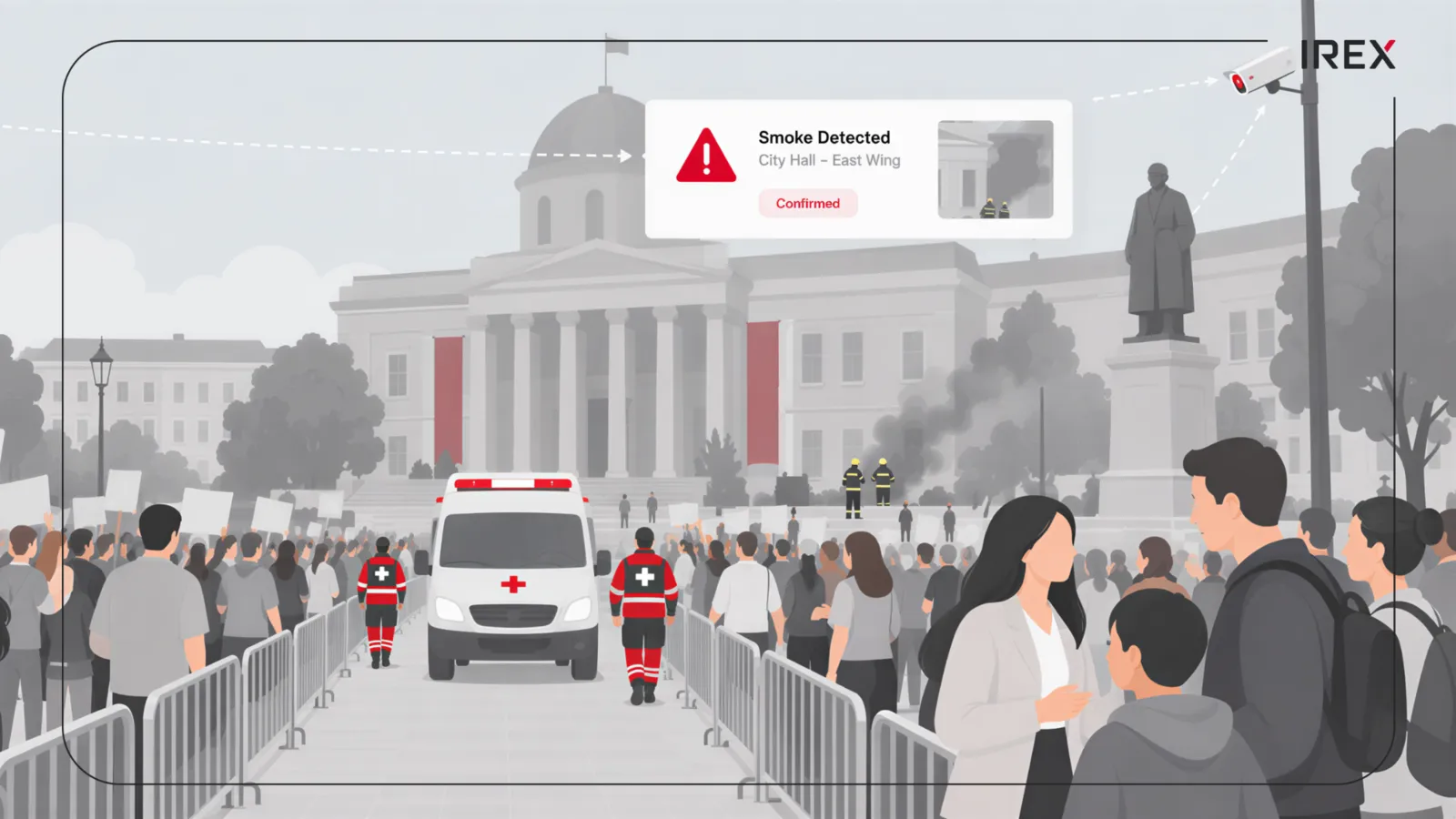
Verified information helps response groups act proportionately.
Each capability can be configured around a location, threshold and response procedure. An alert is not a finding of guilt. It is a signal for trained human verification. The response may be medical support, an open emergency route, a facility check or a request for more information.
For unusual local conditions, StreamVLM™ can support prompt-defined detectors. Any detector should be tested against the actual camera view and used with the same human-verification and audit process. A prompt should describe an observable condition, not a vague category such as “suspicious protester.”
During the event: move verified information to the right people
IREX alarm monitors deliver event notifications to authorized users and, through the Sover secure messenger, to response groups. Alerts can include an event image, camera and event names, location and a playback link. Webhooks can send selected events to an external workflow.
This supports proportionate action. A city can keep a lawful route open while addressing a blocked emergency lane. Medical personnel can be sent to a crowd-compression point. A building operator can check a smoke alert. A response team can verify a suspected intrusion before escalating.
The goal is not to generate the maximum number of alerts. The goal is to give the right people a reliable signal about a real safety issue. Crowd density, fire, smoke and perimeter movement describe conditions. They do not establish political intent or criminal responsibility.
After damage occurs: investigate the specific incident
A robbery, arson event or act of vandalism is reconstructed from observations spread across cameras, time windows and sometimes a phone recording from a business or bystander.
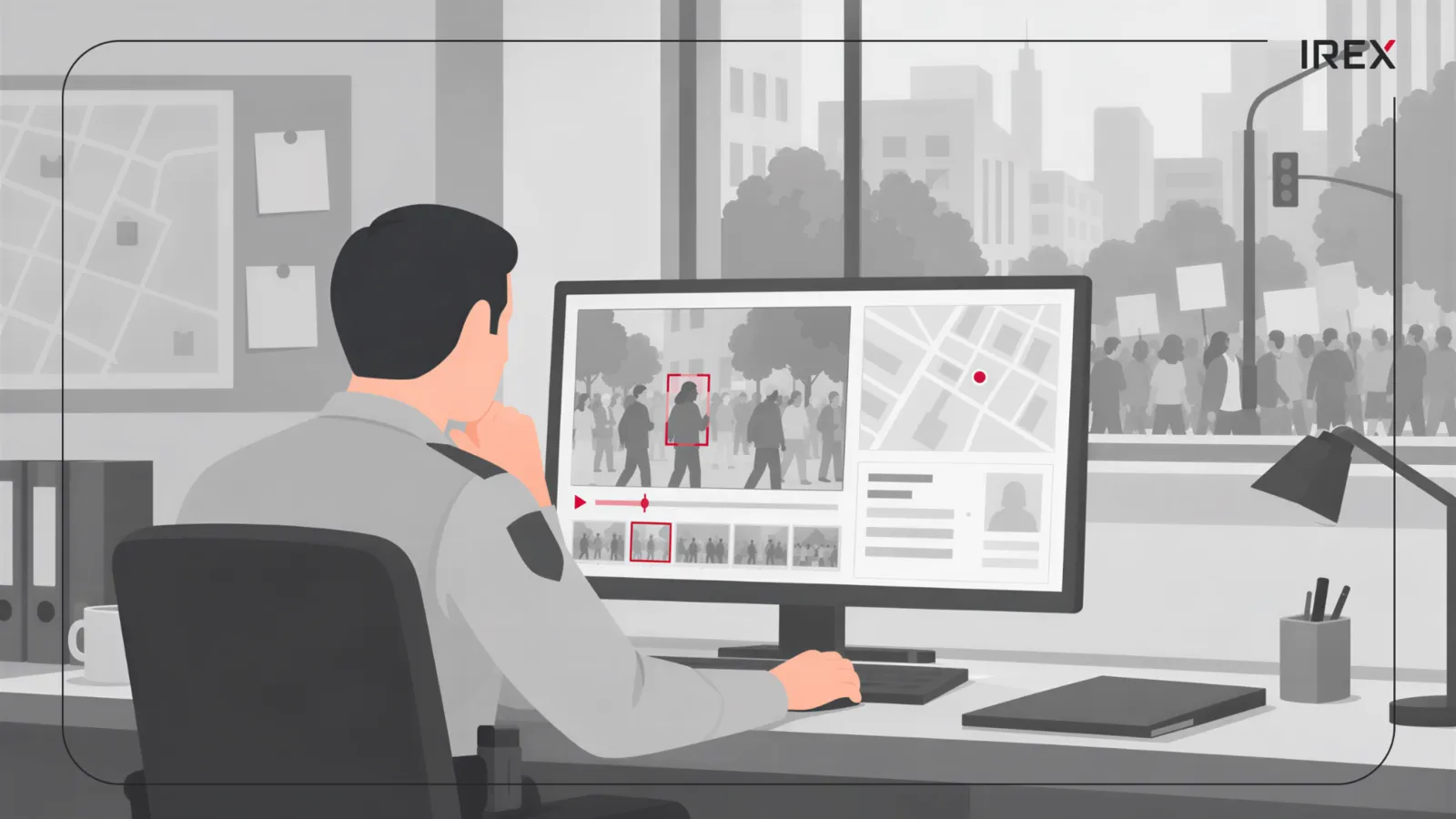
Video analytics can help teams connect an event to the surrounding evidence.
IREX video search can search people, vehicles and events across the archive using natural language, maps or filters. Person re-identification can support an appearance-based search when a face is not visible. Vehicle analytics can search license plates and vehicle attributes when the camera view and image quality meet requirements. Event analytics can connect fire, intrusion, abandoned-object, weapon or audio events to nearby footage.
Investigators can also upload mobile video, analyze it and search the resulting events. This is useful when important footage sits outside the fixed camera network.
IREX does not document a universal robbery detector. Investigators establish a robbery from evidence and lawful investigative work. IREX helps locate, correlate and review video. It does not replace investigators, prosecutors, courts or judgment.
Case ID keeps powerful tools accountable
IREX binds high-risk operations to a Case ID. This includes people searches, vehicle searches, event searches, watchlist management, alarm-monitor management, media management and live or archived video access.
The Case ID records the legal or operational reason for the action. Each action records the operator identity, the action taken, the time and the Case ID. Authorized supervisors can search the Logbook by Case ID, user, event type or time range. Signed log files are exported daily to a secure archive so an oversight body can review the record and detect tampering.
The same controls apply to investigation agents. Agents operate within the human operator’s permission boundaries, cannot escalate their own access and remain attributable to the initiating operator and Case ID.
Facial recognition requires particular care. IREX limits biometric use to pre-identified persons relevant to an active case. A face search requires a Case ID or equivalent lawful authorization, is restricted by role and is logged. EU customers must confirm that national law permits the proposed use. Where real-time biometric identification is not lawful, cities can use non-biometric analytics and targeted post-event investigation.
Case ID connects a sensitive action to its stated legal or operational purpose.
Public safety that protects public life
The strongest case for AI during a protest is not that it can watch more people. It is that it can help responders protect people more precisely.
IREX can help a city identify a fire before it reaches a crowd, keep an emergency corridor open, locate a person who needs medical help, detect dangerous crowd compression, protect a facility and reconstruct a defined criminal incident afterward.
That is the practical model: objective alerts, human verification, focused investigation and a permanent accountability record. It gives cities a way to support public safety without treating democratic participation as a security problem.